
Running a Sex Offender Check in Upshur County
The Texas Public Sex Offender Registry is the main public channel for an Upshur County sex offender check. Texas DPS maintains the statewide data and lets a reader search by name or geography. A county filter can gather records tied to Upshur County, while a city, ZIP code, or address search can narrow the area around Gilmer, Big Sandy, Ore City, or another community. The portal requires users to accept its terms and warnings before searching.
Start with the fact you know best. A name search is useful for checking a specific person, but spelling, aliases, and similar names matter. An address and radius search is better for learning what the registry reports near a point. The county filter gives broader Upshur County coverage, though it may be less useful for a small area. The National Sex Offender Public Website adds a cross-state search of participating jurisdictions. Differences between official searches can reflect scope, update timing, search logic, or the location data each system receives.
Upshur Registry Area Searches
An address-radius search and a city search are not the same Upshur County registry check. The first asks what registered locations fall within the portal's available distance around an address. The second asks for records associated with a city value. A county search casts a wider net. Use more than one geographic mode when a road, mailing address, or city boundary could affect the result.
Gilmer is the county seat and the main justice hub, but an Upshur County address can sit outside a city police jurisdiction. Big Sandy and Ore City also have their own city boundaries. Do not infer which agency handles registration from a postal city alone. The profile's registering-agency information and a call to the proper local authority provide a sounder answer.
Searching the Texas Public Sex Offender Registry
Texas DPS runs the public registry search for the state. It covers statutorily public registration information, not all criminal history. The safest Upshur County sex offender search begins with broad criteria, then uses profile fields to separate people with similar names. Searchers should also note when the screen was checked because a later verification or address update can change the public record.
- Open the official Texas DPS registry and read and accept the conditions of use.
- Choose a name search or enter an address, city, county, ZIP code, and available radius for a geographic search.
- Review the results without relying on a name or map point alone. Compare the identifying details that DPS makes public.
- Open the full profile and read the offense, registration, verification, risk, location, and registering-agency fields that are available.
| Field Label | Type | Required | Notes |
|---|---|---|---|
| Last Name | Text | Mode dependent | Starts a surname search |
| First and Middle Name | Text | No | Narrows name candidates and helps with aliases |
| Address | Text | Geography mode | Sets the point for a proximity search |
| City and ZIP Code | Text or select | No | Focuses on a local place or five-digit area |
| County | Select | No | Select Upshur for countywide results |
| Radius | Select | Address mode | Use the distances shown by the live portal |
| Map or List | View control | No | Changes how geographic results are displayed |
The DPS search screen shown in the official source keeps these name and place controls together.
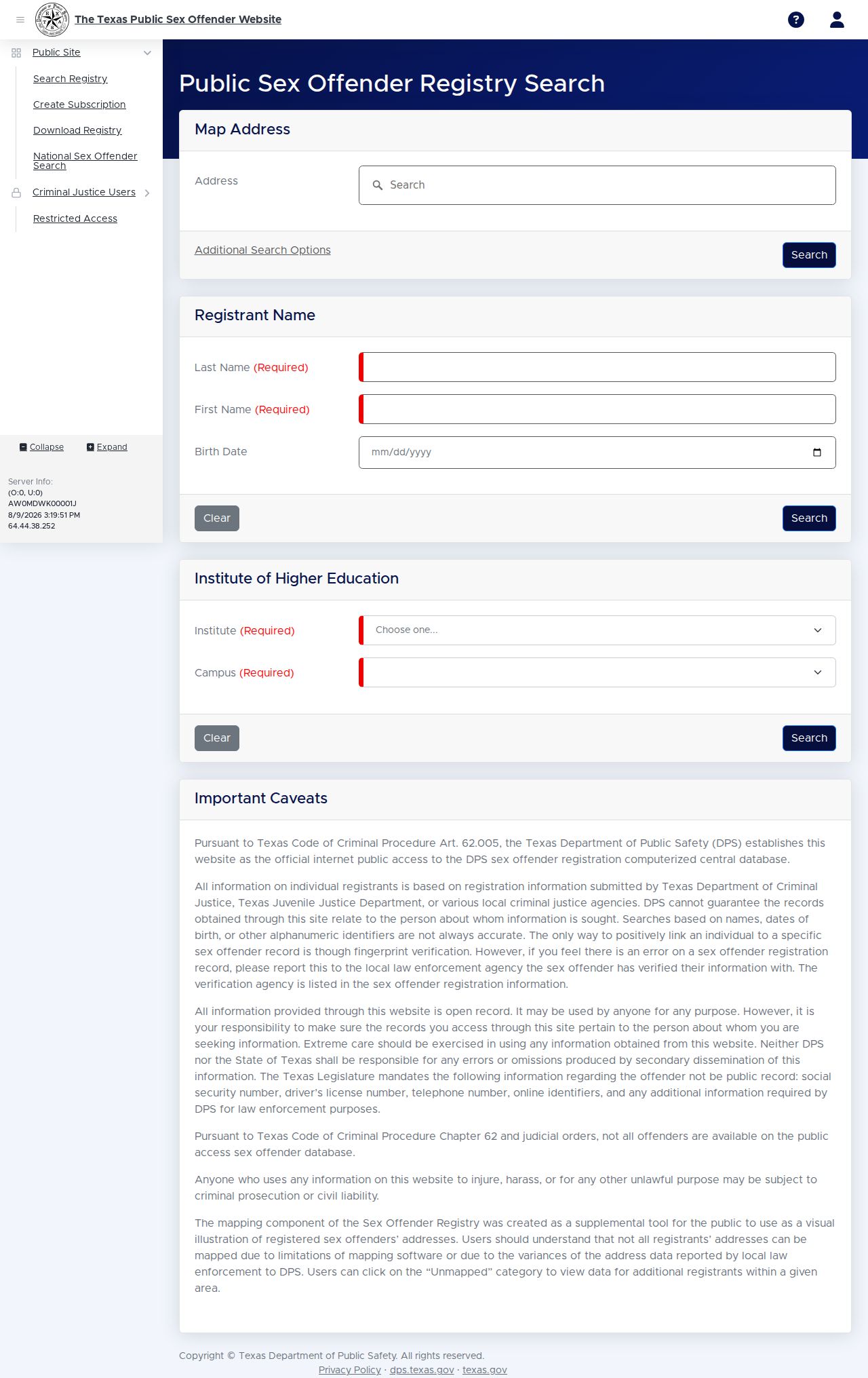
This neutral search view shows how an Upshur County query can begin without displaying or republishing any private person's profile.
What a Registry Profile Shows
A DPS public profile can combine identity, appearance, address, offense, and registration facts. Availability varies by record, so a blank field should not be filled by guesswork. The record may show registration and verification status, a risk level when assigned, and the authority responsible for registration. None of those fields proves current misconduct.
| Name & Aliases | Published names and aliases used to distinguish candidates |
|---|---|
| Photo & Description | Current photograph when available, plus sex, race, height, weight, hair, eyes, age or birth date, scars, marks, and tattoos |
| Registered Locations | Address and other registered location information available for the record |
| Vehicle Details | Registered vehicle information when the profile makes it public |
| Offense & Statute | Offense description, statute, conviction or adjudication date, jurisdiction, and victim age or sex category |
| Risk Information | Risk level when one has been assigned; it is separate from registration duration |
| Registration Status | Start, end, or lifetime status, verification or compliance information, and registering or supervising agency contacts |
Read dates by their labels. A conviction date is not a verification date, and neither is an address update. The registry is one public record channel, while an Upshur County criminal case file can supply the filed charge, judgment, and sentence history.
Correcting Upshur Registry Questions
If Upshur County registry information looks old or conflicts with another official source, record the profile field and the date observed. Then contact the registering authority identified by DPS. The authority can decide whether the issue reflects update timing, a duty that has not yet come due, a different registered location, or suspected noncompliance. A reader cannot make that legal finding from the public screen alone.
NSOPW and Texas DPS results may differ because one is a national query layer and one is the state source. Search both when a person or location may cross state lines, but return to DPS and the proper local registration agency for Texas details. For suspected noncompliance in unincorporated Upshur County, call the sheriff instead of attempting to verify the address in person.
Note: A missing result means only that the chosen criteria returned no candidate in that channel at that time.
Registration Requirements and Levels in Texas
Texas does not use a simple public three-tier chart to set every registration end date. Under Code of Criminal Procedure Chapter 62, duration is driven by the reportable offense and other statutory categories. Risk level, verification frequency, and duration are separate facts. Article 62.101 generally identifies lifetime categories and other cases that end on the tenth anniversary of release from confinement or discharge from supervision. Juvenile rules and possible early termination under article 62.404 add further limits.
| Texas category | Duration | Verification frequency |
|---|---|---|
| Listed serious or repeat categories | Generally lifetime under article 62.101 | Annual, 90-day, or 30-day schedules can apply by statutory category |
| Other reportable convictions | Generally through the tenth anniversary of release or discharge from supervision | The applicable Chapter 62 schedule controls |
| Juvenile or early-termination provisions | Special rules apply; qualifying people may seek early termination under article 62.404 | Depends on the governing provision and status |
An Upshur County profile should be read against the current statute and the offense shown. A risk label does not, by itself, tell a reader when registration ends. Likewise, frequent verification does not create a separate public duration tier. Confirm a hard legal question with the registration authority or qualified counsel.
Upshur Distance Rule Limits
No verified county-specific residency-distance ordinance appeared in the official Upshur County sources reviewed. Texas readers should not assume a single blanket statewide school or park distance rule based on a map result. Court orders, supervision terms, municipal rules, and the facts of a case may create distinct limits. A registry radius is a search tool, not a legal boundary.
The Texas DPS registry landing page and lawful-use notices show the neutral public-safety context for the system.
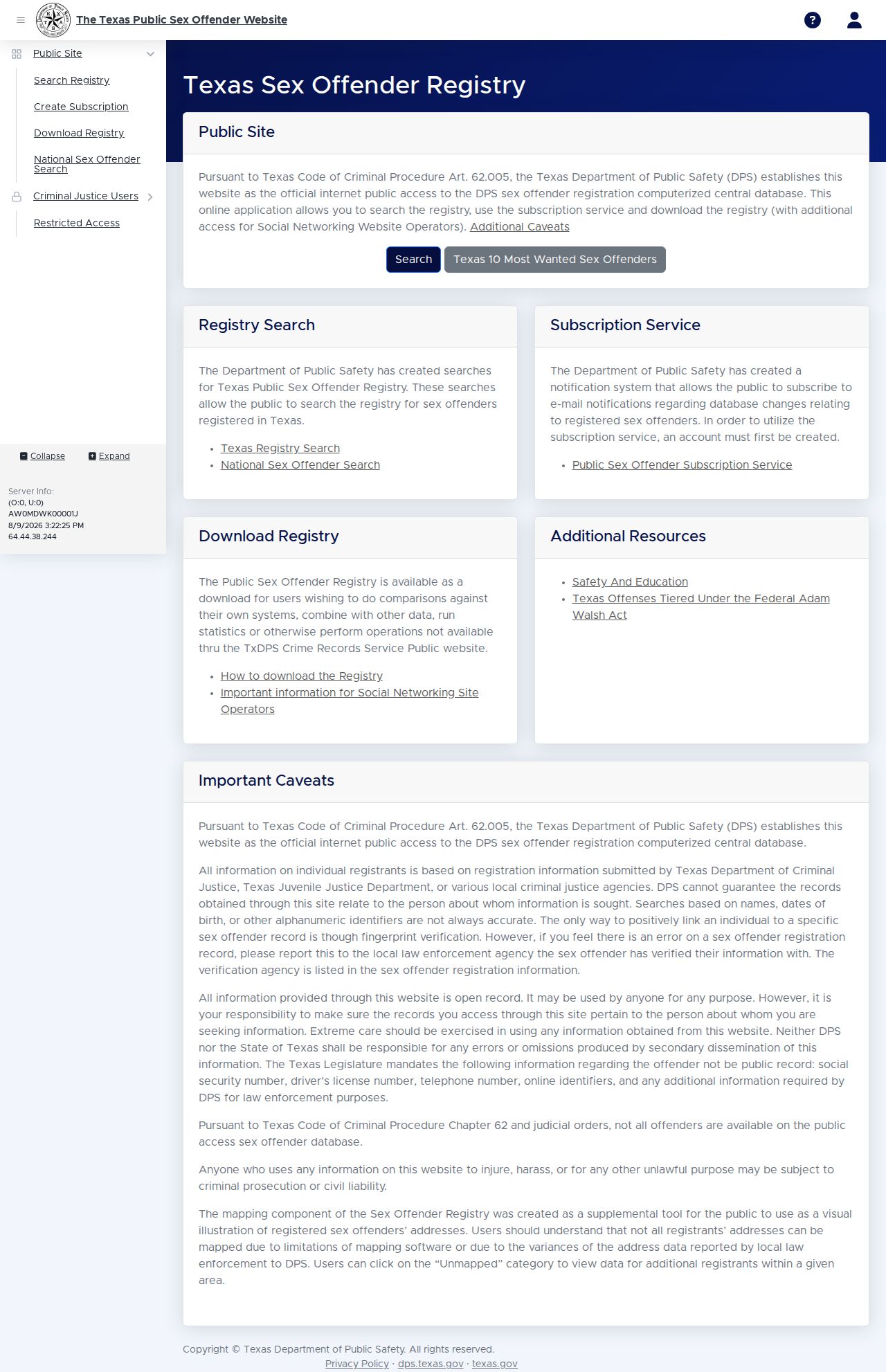
The state landing page is the right place to review current notices before using location data for awareness and safety planning.
Lawful Use and Community Notification
Registry information supports personal safety and community awareness. It may help a resident understand public registration information near an Upshur County address or confirm which local authority is listed on a profile. It does not authorize private investigation, confrontation, trespass, threats, or punishment. Report a suspected compliance issue to the proper police department or the Upshur County Sheriff.
Misuse Is a Crime: Code of Criminal Procedure Chapter 62 does not permit anyone to use registry information to threaten, harass, or commit a crime against a registrant or another person. Use the data only for lawful public-safety purposes.
Community notification and public registry access do not settle whether current conduct has occurred. Law enforcement evaluates reports, and courts decide charges. Keep the profile URL, note the field at issue, and give those facts to the responsible authority. This approach protects the reporter, avoids escalation, and gives Upshur County officials a clear issue to review.
Reporting Upshur Registry Noncompliance
A suspected Upshur County registration violation should be reported, not investigated by a resident. Note the public profile, the field that raised concern, and the time it was viewed. For a location inside a city, begin with the police department that serves that address or the registering authority named on the profile. For unincorporated Upshur County, contact the sheriff at the Justice Center.
Describe the observed issue without claiming that a crime has been proved. An old date, a different map point, or a status label may need context from the agency's nonpublic compliance file. The authority can compare the report with the applicable Chapter 62 duty and decide what action, if any, is lawful. This keeps enforcement with trained officials and helps avoid harm caused by a false assumption.