
How to Check Criminal History in Upshur County
No single search returns a complete Upshur County criminal history. Start with the record closest to the event. The county government directory routes readers to the Sheriff, District Clerk, County Clerk, and local courts. The Sheriff publishes a current Daily Jail Report, the District Clerk keeps felony cases in the 115th District Court, and the County Clerk keeps Class A and B misdemeanor files. Municipal and justice courts retain many fine-only cases. A statewide court index and the Texas DPS public history product add broader views, but neither replaces the local file.
Read each result in context. A jail entry describes custody and the allegations shown when the report was generated. A clerk file shows what prosecutors filed and what the court did. A DPS name result is a public statewide conviction and deferred-adjudication product, not a fingerprint confirmation. Spelling variants, aliases, reporting lag, sealed material, and records kept by different courts can produce different answers. When a result matters, request the underlying judgment, docket sheet, or agency report instead of relying on a short index line.
- Check the Sheriff’s Daily Jail Report for a recent booking, then note its timestamp and any listed SO number.
- Ask the District Clerk about felony filings and the County Clerk about Class A or B misdemeanor filings.
- Contact the issuing municipal or justice court for a city citation, Class C charge, capias, or court-specific warrant.
- Use re:SearchTX and the DPS public search as statewide layers, while recognizing their coverage and identity limits.
- Order the source document or use fingerprint review when an identity-linked official record is required.
Why Upshur County Records Split
Upshur County criminal records divide by offense level and by the office that created them. The felony custodian is the District Clerk for the 115th District Court. The County Clerk holds Class A and B misdemeanor cases. A justice or municipal court may hold a Class C matter, while the Sheriff holds county arrest reports and jail booking sheets. The Criminal District Attorney screens cases and presents felony matters to a grand jury, but the prosecutor’s file is not the same as the clerk’s public court file. This division makes the right office more important than the broad phrase “county records.”
The Upshur County District Clerk page identifies the felony custodian and its Justice Center counter.
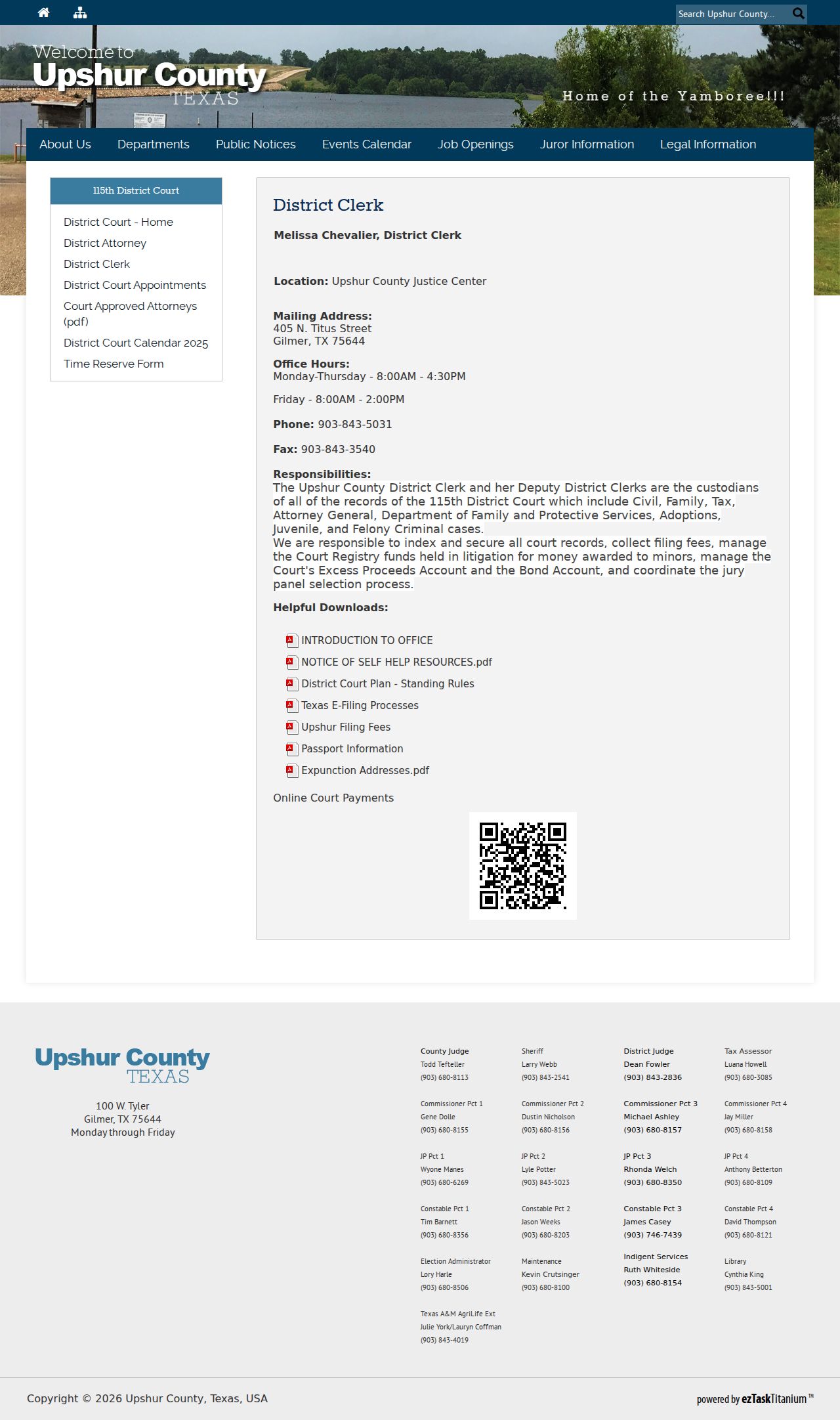
That official page is the correct starting point for indictments, felony docket sheets, judgments, sentences, and motions filed in Upshur County.
The Upshur County Clerk page marks the separate misdemeanor route.
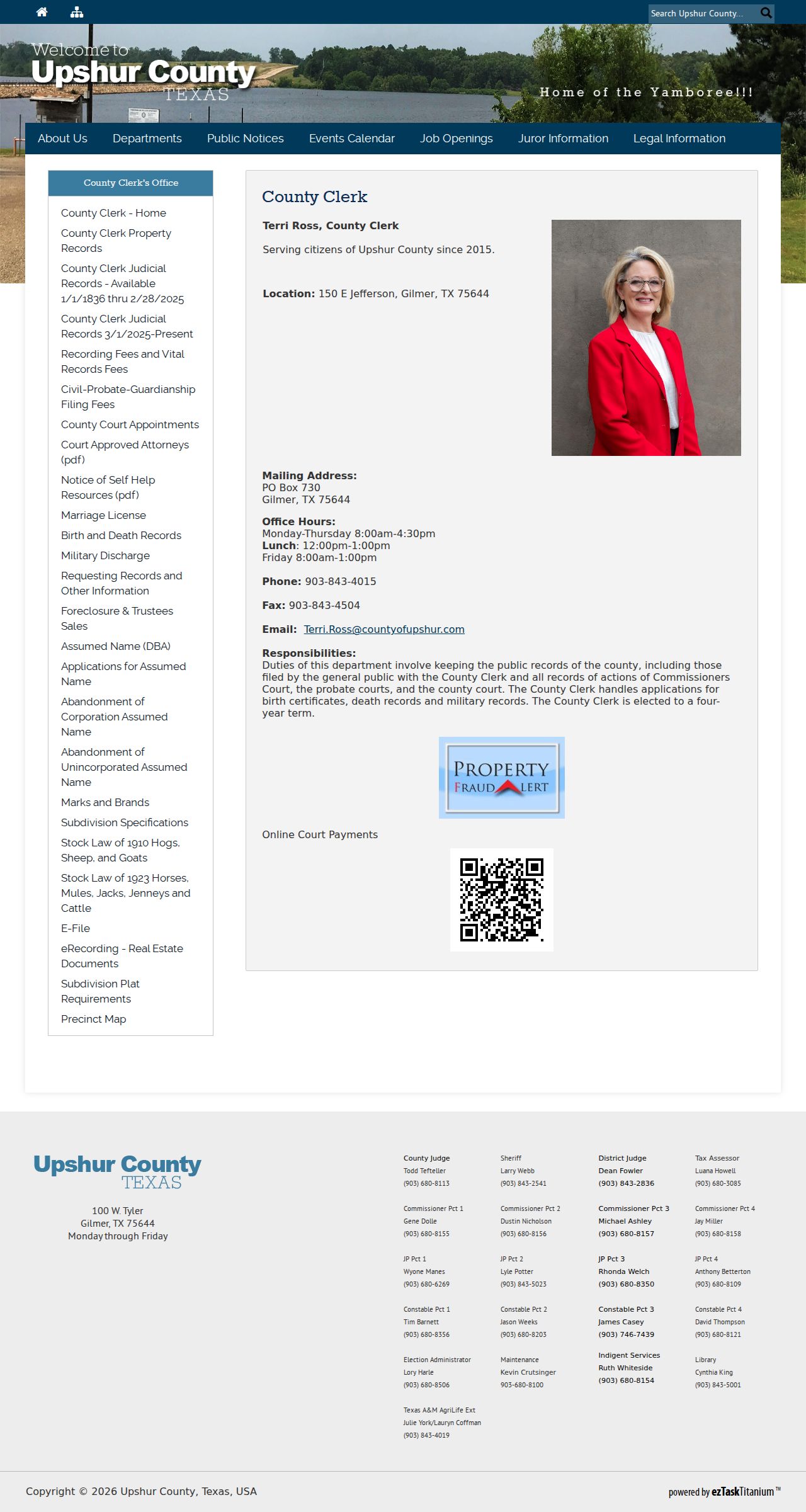
Searching both clerks prevents a felony-only check from being mistaken for a complete local court search.
Official Texas Background Checks
The Texas Department of Public Safety Crime Records Division maintains the central state repository. Its public Criminal History Search returns the conviction and deferred-adjudication information that state law permits DPS to release. An account and prepaid credits are required. Each online search uses one $1 credit; a card purchase adds 2.25 percent per credit and a 25-cent transaction fee. Form CR-42 offers a separate mail search for $10. Both public products match names and other identifiers, so a candidate is not proof of identity.
For review of one’s own identity-linked Texas record, fingerprints are the more reliable route. DPS Fingerprint Applicant Services of Texas uses IDEMIA/IdentoGO electronic capture and the service code supplied by the authorized agency. Program totals vary, although the DPS FACT table lists basic components of $10 for IDEMIA, $15 for DPS, and $12 for the FBI. No permanent Upshur County enrollment site was verified, so use the appointment locator rather than assuming a Gilmer location. An FBI Identity History Summary is a separate federal personal-record product.
Upshur County DPS Search Choices
The Texas DPS Criminal History Search instructions explain the account, credit, and match process that applies to Upshur County names.
This statewide product is useful for public convictions and deferred adjudications reported to DPS. It does not replace the Upshur County clerk’s pleadings, docket events, or judgment. A no-match result can also miss a record under another identifier or one outside the public slice.
Use the strongest identifiers the portal accepts. Run an alias as a separate search rather than placing two names in one field. Each submit action may consume a credit, so review the entry before sending it.
| Field | Use | Match value |
|---|---|---|
| Last name | Required | Search current legal name and known aliases separately |
| First name | Required | Reduces broad surname results |
| Middle name | Optional | Helps distinguish common names |
| Date of birth | Strong identifier | Greatly improves candidate matching |
| Sex and race | Portal dependent | Narrows candidates but does not prove identity |
Types of Criminal Records
An Upshur County arrest can create several documents. The arresting agency writes an offense or arrest report. Jail staff make a booking entry. A magistrate records warnings, probable cause, and bail action. The prosecutor may later file an information or present a felony to the grand jury, after which the correct clerk builds the court case. Fingerprints and disposition data may also reach DPS. These files have different authors and update cycles, so one can exist before another appears.
The county’s criminal court payment page visibly separates misdemeanor payments handled through the County Clerk from felony payments handled through the District Clerk.
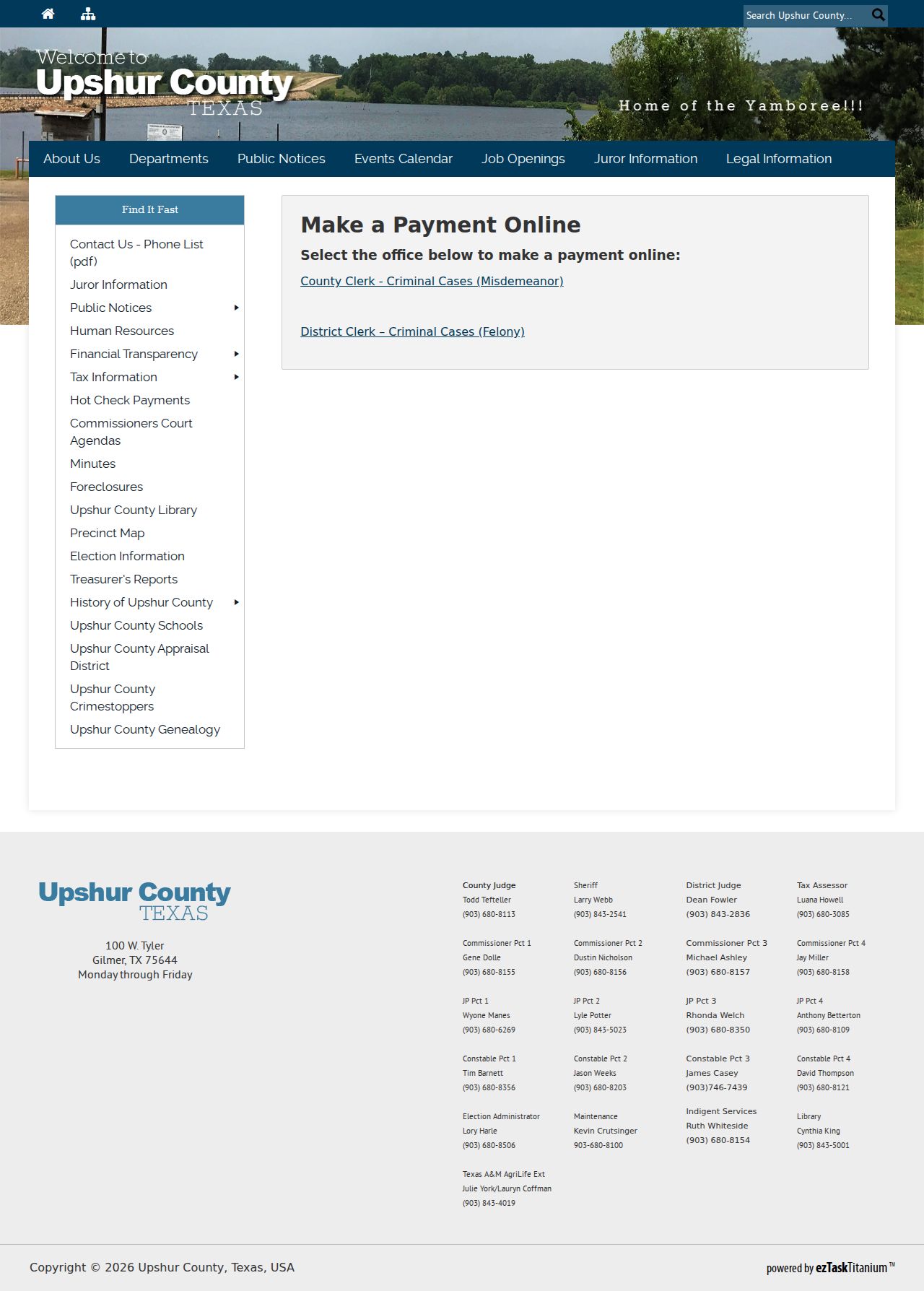
A payment screen is not a full case search. It may omit filed papers, dismissed counts, sentence terms, or later orders, so obtain the clerk’s docket and judgment when the case outcome matters.
- Arrest and booking records: agency reports describe the event, while jail entries document intake and custody allegations.
- Criminal court files: clerks retain charges, settings, motions, pleas, judgments, sentences, and costs.
- DPS history entries: the repository links reported arrest cycles and dispositions, with a narrower public name product.
- Warrant records: the issuing district, county, municipal, or justice court controls the underlying docket.
- Supervision and registry records: CSCD, TDCJ, the parole system, and DPS each maintain a distinct part.
Upshur County Jail Report
The Sheriff does not offer a conventional live inmate search box. Instead, the official office page links a timestamped Daily Jail Report PDF. It can show the booking date, displayed name, date of birth, location, SO number, charge description, court or reporting label, charge disposition, and bond amount. The report is a current-custody snapshot. A blank disposition does not mean dismissal, and the short court label may not identify the final trial venue.
The Upshur County Sheriff page is the official gateway to the jail report and the public-information form.
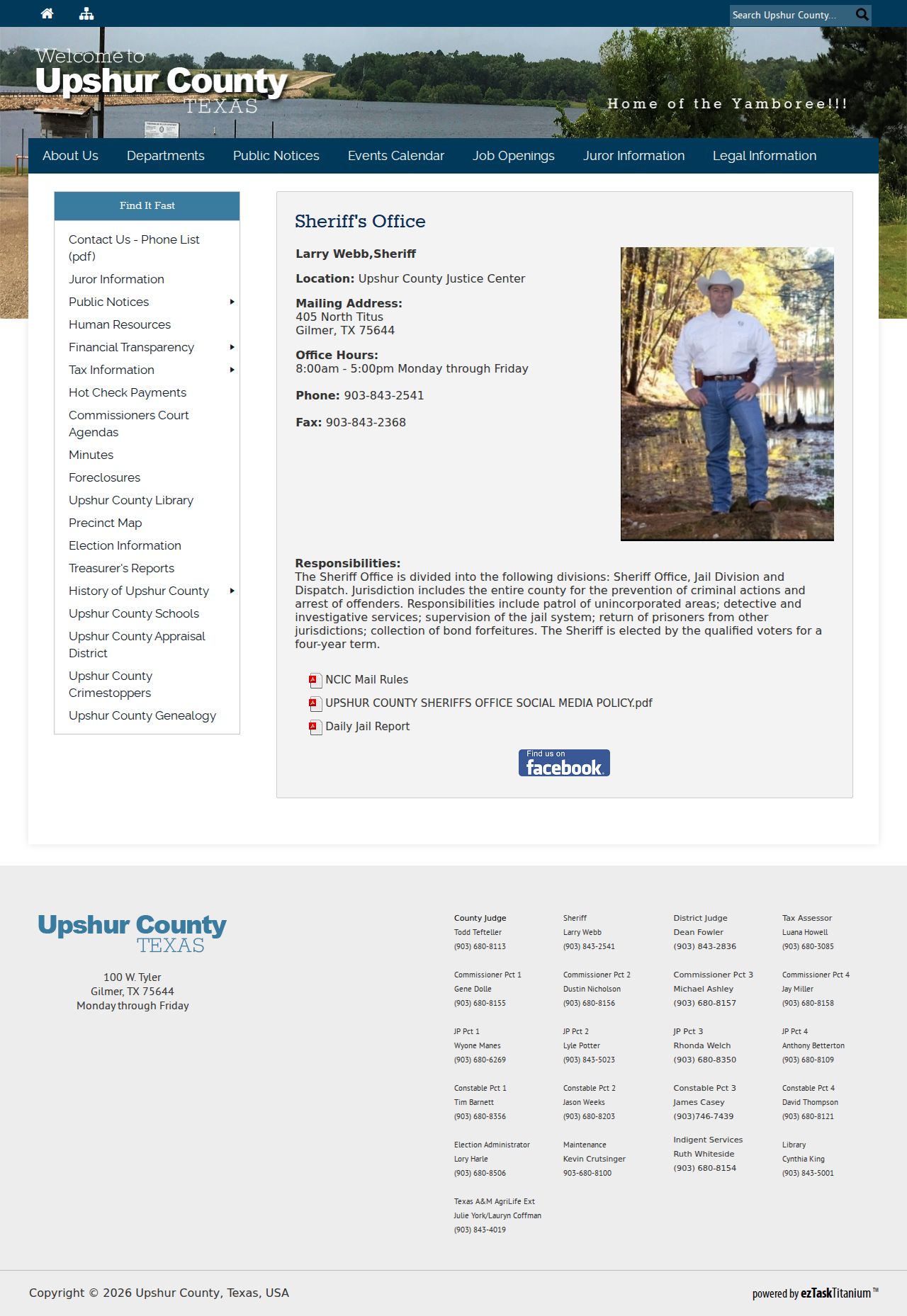
Check the report’s generated time, then call 903-843-2541 for current bond, transfer, or release status. Historical Jail Book In/Out Sheets can be requested in writing when the person no longer appears in the current PDF.
Note: A booking charge may change after prosecutor review, so follow the allegation into the appropriate clerk’s filed case before drawing conclusions.
What an Upshur County Criminal Record Shows
A full Texas criminal history organizes data around identity and arrest cycles. It may include legal names and aliases, birth date, descriptive identifiers, state or FBI numbers, arrest agency, event-control numbers, charges, statutes, court tracking, disposition, sentence, and later custody or supervision events. Public products remove protected identifiers and may exclude nonpublic events. Local Upshur County files can provide more case detail, including attorneys, settings, motions, bond papers, orders, fines, and costs, without serving as a complete statewide history.
| Name & identifiers | Legal name, aliases, date of birth, descriptors, SID, and sometimes an FBI number. |
|---|---|
| Arrest / booking data | Arrest date, agency, booking number, fingerprint event, listed charge, bond, and custody site. |
| Charges & statutes | Alleged or filed offense text, degree or class, and cited Texas law. |
| Disposition | The outcome of each filed charge, such as conviction, dismissal, acquittal, or deferred adjudication. |
| Sentence | Jail or prison term, fine, costs, restitution, or community supervision ordered by the court. |
| Custody / supervision | County jail, TDCJ placement, probation, parole review, or release data where public. |
The Upshur County Criminal District Attorney page describes the office that screens and prosecutes local criminal matters.
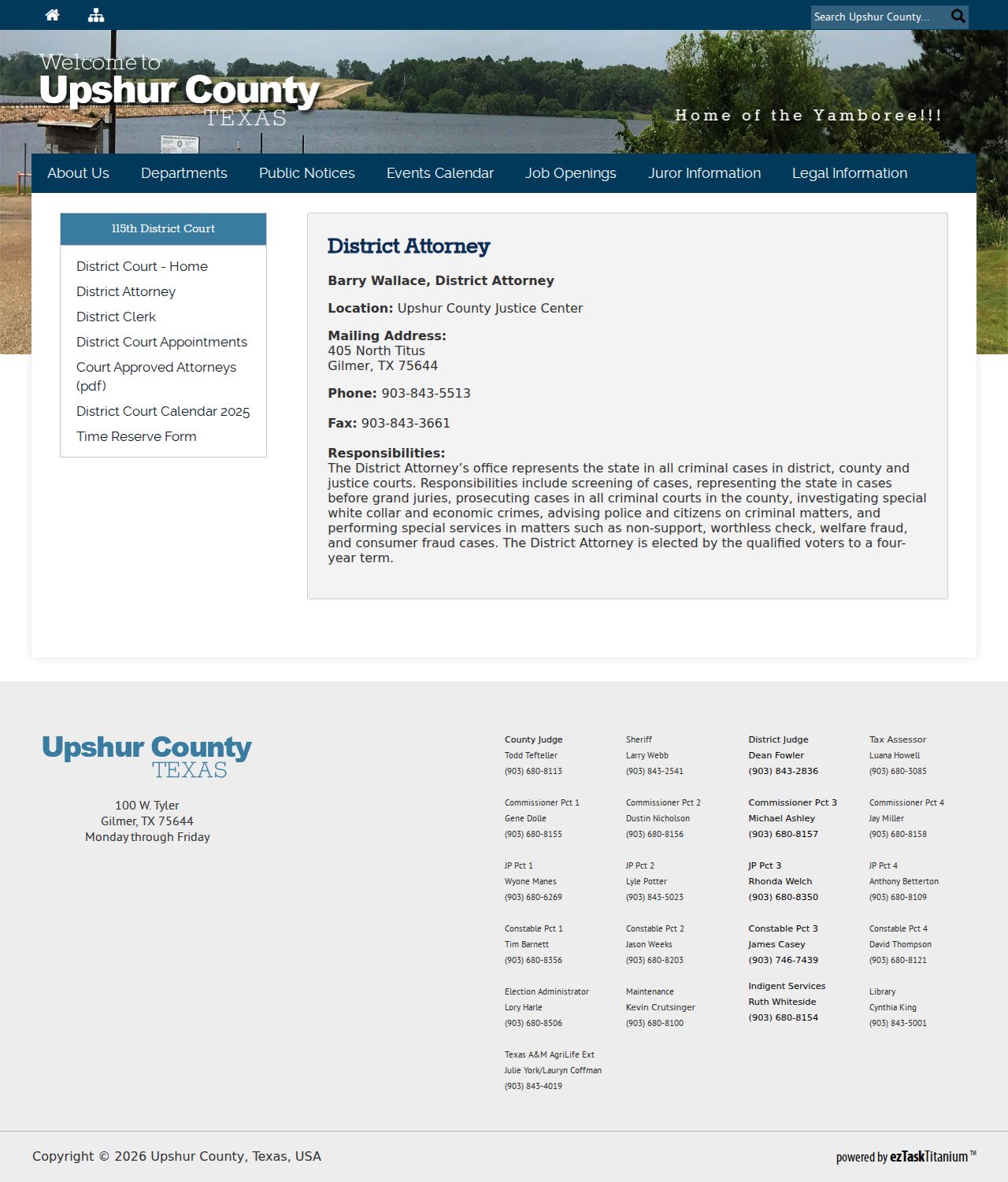
Prosecutor screening explains why the charge in a clerk file may differ from the allegation printed on an earlier booking report.
Upshur County Custody Records
County jail, TDCJ, and Texas VINE answer three different custody questions. The Upshur Daily Jail Report covers a person held in the local jail when the PDF was generated. The TDCJ Online Inmate Search becomes the proper locator after transfer to state prison or state jail custody. It accepts a TDCJ number or SID, or a name with optional race, gender, and exact date of birth. Texas VINE offers change notifications but does not replace the jail or TDCJ as the source record.
The 115th District Court page identifies the felony court whose judgments can lead to state custody.
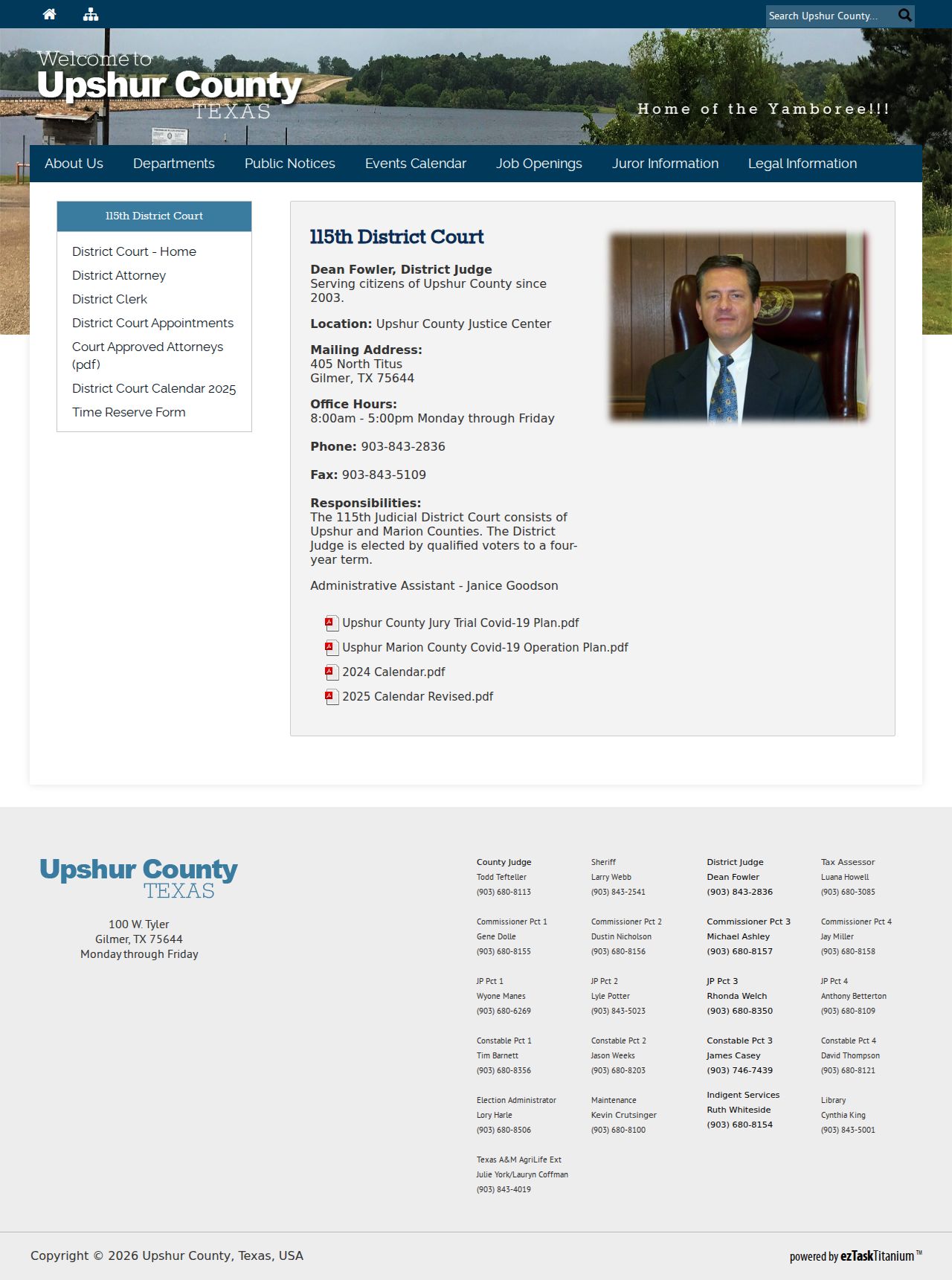
The 115th Judicial District serves both Upshur and Marion Counties. The judge’s shared district does not merge the clerk files, so confirm the filing county before requesting a judgment.
The safe custody sequence is simple: review the county PDF, confirm present status by phone, use TDCJ after state transfer, and use the federal Bureau of Prisons only for federal custody. A person can vanish from the county snapshot because of release or transfer, not because the historical record ceased to exist.
Public Access Laws
Public access starts with the office that maintains the record. The Texas Public Information Act requires prompt handling of requests for existing government records, but it does not require an office to research a question or create a custom criminal history. Court access rules, DPS dissemination law, expunction law, and registry law then control particular records. Active investigations, juvenile data, victim details, sealed material, biometric information, and sensitive identifiers can be withheld or redacted.
Key Texas laws:
Government Code Chapter 552 gives the public a route to existing government records and sets prompt-response duties.
Government Code Chapter 411 governs DPS criminal-history dissemination and orders of nondisclosure.
Code of Criminal Procedure Chapter 55A controls expunction eligibility, petitions, service, and legal effect.
Code of Criminal Procedure Chapter 62 controls sex-offender registration, verification, and public information.
A Sheriff request should identify a document, such as an incident report, booking sheet, CAD log, or releasable warrant entry. A clerk request should identify the court file and desired document. Naming the record lets the custodian search what it already holds without being asked to give a legal conclusion.
Upshur County Warrant Record Chain
No official countywide active-warrant portal was found. Use the fallback chain instead. Call the Sheriff about warrant information the office can release, submit a narrow Chapter 552 request, and contact the court that may have issued the warrant. Upshur County justice courts issue arrest and search warrants and conduct magistration. Municipal courts control capias and failure-to-appear matters from their own cases, while district and county clerk dockets may show warrant activity in filed cases.
A warrant may be sealed, and the absence of a public list is not proof that none exists. Do not walk into a counter expecting staff to guarantee that an arrest will not occur. Obtain the case or warrant number by phone, ask the issuing clerk about appearance or bond procedure, complete the required court action, and confirm that clearance was sent to law enforcement. A payment may not update every system at once.
- Capias
- A court command directing that a person be taken into custody.
- Capias pro fine
- A custody process tied to an unresolved fine or judgment, subject to ability-to-pay safeguards.
- Magistration
- The early warning, probable-cause, rights, and bail process after arrest.
- Surety bond
- A release bond backed by a surety or bond company.
Sealed, Expunged & Restricted
Texas expunction under Chapter 55A can require qualifying records to be destroyed or deleted and usually permits denial that the event occurred. Possible paths include acquittal, pardon, identity theft, and some dismissals or no-bills after statutory conditions are met. Eligibility depends on the charge, timing, and later history. The word “dismissed” alone does not prove that an Upshur County record qualifies or that a booking entry has already disappeared.
An order of nondisclosure is different. It limits public release but preserves access for criminal-justice agencies and other entities authorized by law. Deferred adjudication may support nondisclosure when expunction is unavailable. Juvenile records, victim information, Social Security numbers, driver-license data, medical details, sealed warrants, and grand-jury material also receive separate protection. After any relief, check both the county systems and one’s own DPS record because updates do not always appear at the same time.
Upshur County Expunction Routing
Upshur County publishes an unusual practical aid: an agency-address sheet for expunction notices and orders under Article 55A.253. It lists local recipients such as the District Attorney, County Clerk, District Clerk, and Gilmer Police Department, plus the Office of Court Administration. That matters because a city police report, county booking, prosecutor file, clerk case, DPS entry, and state reporting copy can sit with different custodians.
The current filing fee was not confirmed in the official research. Ask the District Clerk for the latest filing-fee document before filing. A petition generally goes to an authorized district court, identifies the agencies believed to hold the record, includes the required arrest and charge details, and follows the service and hearing process in Chapter 55A. Omitting a custodian can leave a copy outside the order’s routing. Legal advice should come from a qualified Texas attorney.
The Upshur County Victim Services page shows another justice function housed with the local prosecution system.
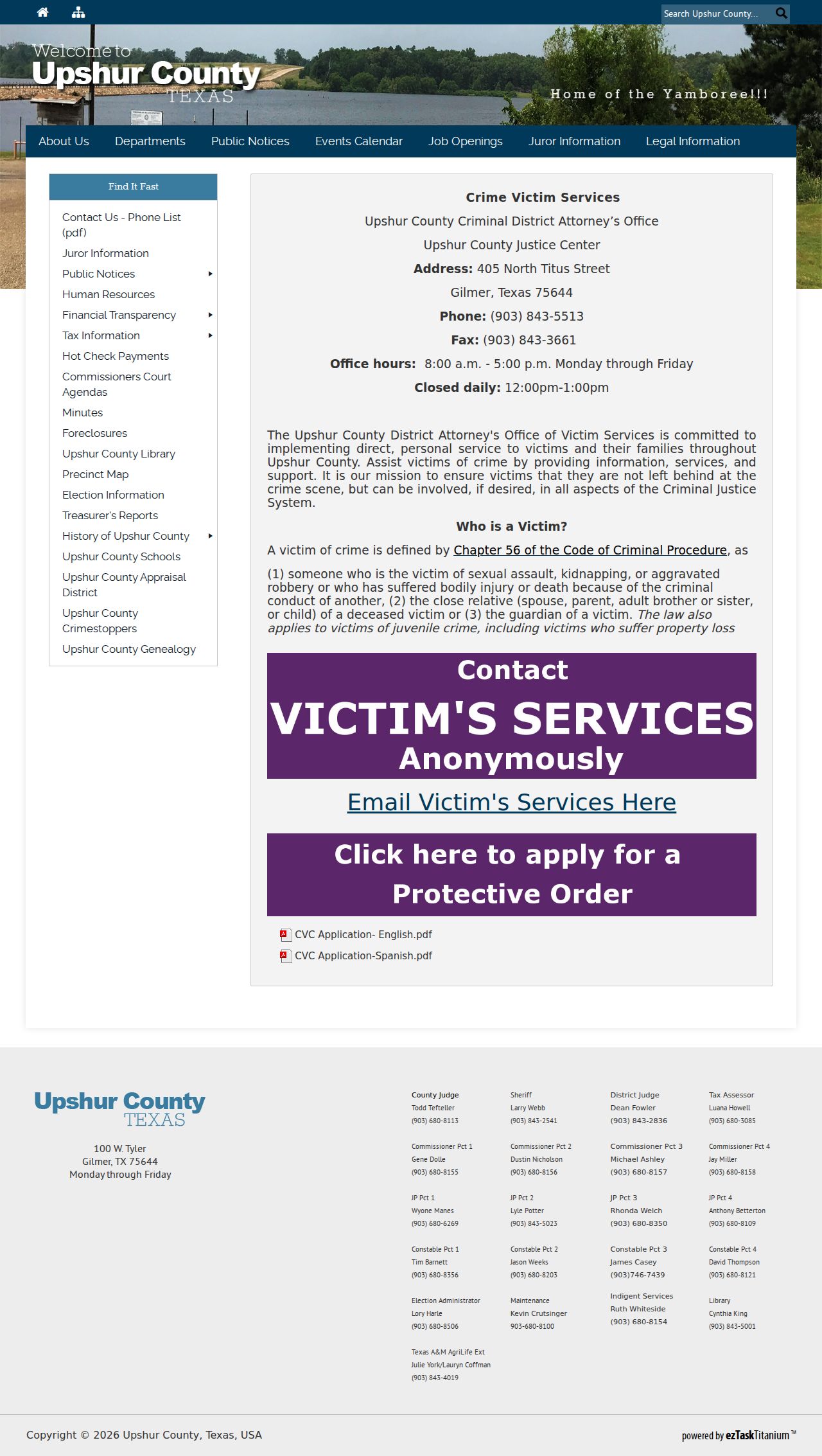
Victim-services records can contain protected personal details, so public court access does not make every item in an agency file available.
Criminal Records by City in Upshur County
City police departments keep the reports they create, even when the person is booked into the Upshur County Jail. Municipal courts also retain their own ordinance, fine-only, citation, and court-warrant files. Gilmer, Big Sandy, and Ore City therefore each add a local first stop to the county chain. A higher-level charge then moves to the County Clerk or District Clerk, based on its class. No population numbers are shown because the official research did not safely establish a current estimate.
Gilmer Criminal History
County seat · City police reports and municipal court files remain separate from county clerk records.
Big Sandy Criminal History
City records · Police reports begin with the city, while booked custody routes through the county jail.
Ore City Criminal History
City records · Municipal matters stay local and higher charges move to the appropriate Upshur County clerk.
Upshur County Supervision Records
Community supervision and parole are not the same record system. The Upshur County Community Supervision and Corrections Department manages court-ordered probation and deferred-adjudication supervision. Its internal officer notes and treatment details are not a general public lookup. A public judgment or docket may still show that community supervision was imposed, so begin with the sentencing court before asking CSCD what it may lawfully confirm.
The Upshur County CSCD page gives its local office route and business hours.
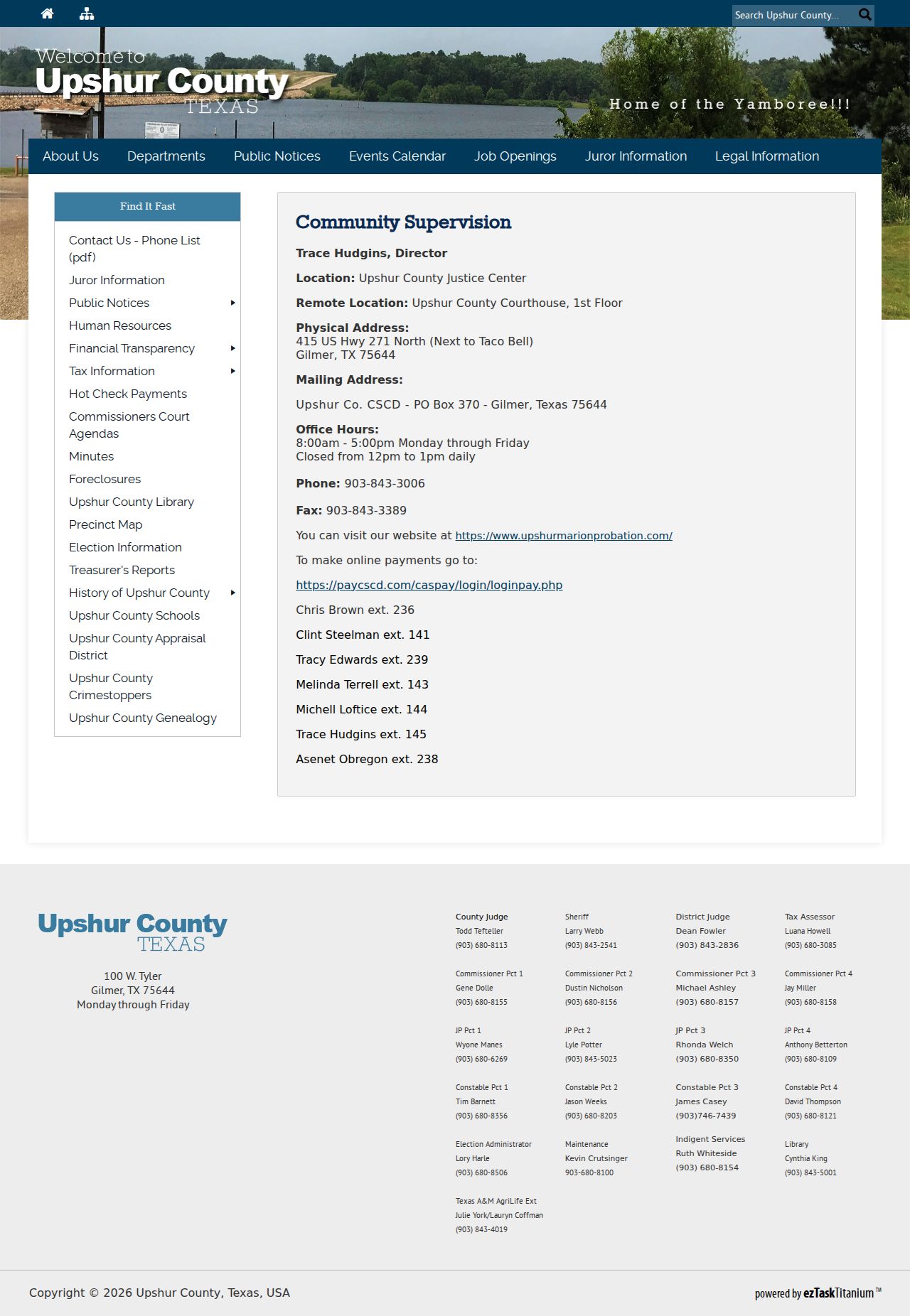
The office is at 415 U.S. Highway 271 North in Gilmer, open weekdays from 8 a.m. to 5 p.m. with a noon-to-1 p.m. closure, and can be reached at 903-843-3006.
Parole decisions belong to the Texas Board of Pardons and Paroles, while the TDCJ Parole Division supervises people released from state custody. TDCJ’s public locator may show custody and parole-review data. Motions to revoke or adjudicate probation, by contrast, appear in the sentencing court file. Match the question to the court, CSCD, TDCJ, or parole authority instead of treating “supervision” as one database.